Those of a certain age who lived in the south-eastern corner of England in the mid-60s will remember the pirate broadcaster 'Radio London' with it's late night programme 'The Perfumed Garden'. The DJ John Peel was the first champion of John Fahey over here, and when he migrated to the new BBC Radio 1 he presented 'Top Gear', where he was able not only to play his own impeccable choice of music, but to have studio sessions with guests.
In 1969 Fahey did a short tour of the UK and appeared on 'Top Gear'. And now I'm able to post the material from that session here as downloads; 'Death of the Clayton Peacock' in particular is a wonderful performance. So here, with thanks to a regular visitor who provided these recordings, are: Bucktown Stomp, The Death of the Clayton Peacock, In Christ the is no East or West, Steel Guitar Rag and Sunflower River Blues.
Wednesday
Monday
Blind Joe Death Transfigured.
Like I did with my earlier post on VOTT, I'm putting this up despite it being very much an unfinished work-in-progress. It'll be considerably expanded and hopefully I'll bring some semblance of coherence and completion over the next few days (make that 'months'!), when I'll enable comment. If it interests you, I hope you'll come back later to catch the full post.
Unless you've started worrying which, if any, of his records John Fahey actually played on, the second big mystery in his canon is 'Transfiguration'. In particular, why exactly did it come out on an unheard-of Boston record label as it did? Well, it's somewhat like 'Turtle' in that there's an established orthodoxy that is correct only in parts. The consensus runs something like this: John Fahey recorded for a mysterious company called Delta. ED Denson stole the tapes from those sessions and sold them to a mysterious Ralph Riverboat; he then released them as 'The Transfiguration of Blind Joe Death' on a mysterious and utterly obscure record label called Riverboat. It came out in 1965, ahead of 'Guitar Volume 4', which was released the following year. And in 1968, Takoma re-released 'Transfiguration', numbering it Volume 5.
From that, there is one certain fact. that 'Volume 4' came out on Takoma in 1966. But there are two definite falsehoods. Takoma did not re-release 'Transfiguration' in 1968, nor did they designate it Volume 5. In fact Takoma did not reissue 'Transfiguration' until 1973, a date that is clearly displayed on the label of their release (see my label entry for 'Transfiguration'). And it would have been pretty pointless them pronouncing it Volume 5, given that Riverboat Records had already done that with the original issue. In between, there's a lot of mythology, and very little that can be stated as absolute fact. There's one person who knows of course, and that's Mr. Denson, but he's unlikely to be telling as he knows how Fahey intended and enjoyed such confusions; and if he did say you wouldn't really know if he was giving you the truth anyway, because he played the same games.
'Transfiguration' came out on Riverboat in an initial subscription edition of 50 copies, probably in late January 1966, with the commercial issue following a little while later; the ED Denson review posted elsewhere here was published in late February, early March that year, which dates it pretty accurately.
It's almost impossible to conceive of how the notion came about that 'Transfiguration' only became Volume 5 when Takoma acquired it from Riverboat, let alone how it gained such currency since. Images of the 'Riverboat' sleeve are so easily available,with most reproductions showing the back as well as the front (Stefan Wirtz for example has it on his Takoma discography). But just in case there's any doubt I'm putting up a photo here:

And then there's the question of that 1968 reissue, the one that didn't actually happen. I am at least able to see a possible explanation for this one, and that is that Transatlantic Records released the record in Europe in 1968. Maybe that release credited copyright to Takoma, and given the Eurocentric dominance in the field of 'Fahey studies' that is how 1968 was seized on as the critical date. And 1968 is certainly one powerful snake oil. Fantasy's CD release has notes by Sam Charters in the accompanying booklet which are clearly dated to 1968 and have an explanatory note appended: that 'ED Denson (Takoma's co-owner) asked Sam Charters to write the notes for the reissue of 'The Transfiguration of Blind Joe Death' when the master was reacquired from Riverboat, however these notes never appeared in the reissue'. All this makes a lot of sense and adds evidential weight to that 1968 date. Because in 1968 ED Denson was indeed still a co-owner of Takoma records. And in 1968 Sam Charters was closely involved with Fahey and Denson through his involvement with Vanguard Records (he's listed as producer and executive producer for the two albums Fahey recorded for Vanguard, and was producer for Country Joe & the Fish, who were also managed by Denson and on Vanguard). It all starts to fall apart however when you read the notes that Sam Charters actually wrote. He talks not only about JF's spell at Vanguard, but his time with Warner Brothers, where he "had the resources to work with an instrumental group, but to everyone's surprise he used traditional jazz musicians... Since then he has returned to Takoma, and there have been new recordings". Sam then goes on to say (somewhat erroneously) that most of the recordings used on 'Transfiguration' come "from close to the end of the Sixties".
Even the IFC are infected with this 1968-mania. In their site section on 'Transfiguration' in the Fahey Files they offer the reissue notes. They still credit Sam Charters' notes as being written for a 1968 reissue, working their way round his apparent clairvoyance by offering only excerpts and omitting all the awkward bits. And in their own Notes on the Songs they repeat the 1968 reissue date and quote from "the original Transfiguration sleevenote". After an extensive quote they add "This account is from 1968..." but by now they've definitely got themselves into something of a muddle. The account is indeed from 1968, but that is because it is actually the 'Turtle' sleevenotes they're quoting. And there are obvious dangers in taking 'Transfiguration's wonderfully surreal notes at face value too readily anyway.
Even when Takoma reissued 'Transfiguration' in 1973, they allocated it an 'R' series number and, other than for the label on the actual vinyl, it continued to be sold as a Riverboat record. They finally packaged it as Takoma around 1976, and that is almost certainly when Sam Charters wrote his reissue notes (which indeed weren't used but are unlikely to have been solicited by ED Denson who had relinquished his business interest in Fahey and Takoma several years before).
Unless you've started worrying which, if any, of his records John Fahey actually played on, the second big mystery in his canon is 'Transfiguration'. In particular, why exactly did it come out on an unheard-of Boston record label as it did? Well, it's somewhat like 'Turtle' in that there's an established orthodoxy that is correct only in parts. The consensus runs something like this: John Fahey recorded for a mysterious company called Delta. ED Denson stole the tapes from those sessions and sold them to a mysterious Ralph Riverboat; he then released them as 'The Transfiguration of Blind Joe Death' on a mysterious and utterly obscure record label called Riverboat. It came out in 1965, ahead of 'Guitar Volume 4', which was released the following year. And in 1968, Takoma re-released 'Transfiguration', numbering it Volume 5.
From that, there is one certain fact. that 'Volume 4' came out on Takoma in 1966. But there are two definite falsehoods. Takoma did not re-release 'Transfiguration' in 1968, nor did they designate it Volume 5. In fact Takoma did not reissue 'Transfiguration' until 1973, a date that is clearly displayed on the label of their release (see my label entry for 'Transfiguration'). And it would have been pretty pointless them pronouncing it Volume 5, given that Riverboat Records had already done that with the original issue. In between, there's a lot of mythology, and very little that can be stated as absolute fact. There's one person who knows of course, and that's Mr. Denson, but he's unlikely to be telling as he knows how Fahey intended and enjoyed such confusions; and if he did say you wouldn't really know if he was giving you the truth anyway, because he played the same games.
'Transfiguration' came out on Riverboat in an initial subscription edition of 50 copies, probably in late January 1966, with the commercial issue following a little while later; the ED Denson review posted elsewhere here was published in late February, early March that year, which dates it pretty accurately.
It's almost impossible to conceive of how the notion came about that 'Transfiguration' only became Volume 5 when Takoma acquired it from Riverboat, let alone how it gained such currency since. Images of the 'Riverboat' sleeve are so easily available,with most reproductions showing the back as well as the front (Stefan Wirtz for example has it on his Takoma discography). But just in case there's any doubt I'm putting up a photo here:

And then there's the question of that 1968 reissue, the one that didn't actually happen. I am at least able to see a possible explanation for this one, and that is that Transatlantic Records released the record in Europe in 1968. Maybe that release credited copyright to Takoma, and given the Eurocentric dominance in the field of 'Fahey studies' that is how 1968 was seized on as the critical date. And 1968 is certainly one powerful snake oil. Fantasy's CD release has notes by Sam Charters in the accompanying booklet which are clearly dated to 1968 and have an explanatory note appended: that 'ED Denson (Takoma's co-owner) asked Sam Charters to write the notes for the reissue of 'The Transfiguration of Blind Joe Death' when the master was reacquired from Riverboat, however these notes never appeared in the reissue'. All this makes a lot of sense and adds evidential weight to that 1968 date. Because in 1968 ED Denson was indeed still a co-owner of Takoma records. And in 1968 Sam Charters was closely involved with Fahey and Denson through his involvement with Vanguard Records (he's listed as producer and executive producer for the two albums Fahey recorded for Vanguard, and was producer for Country Joe & the Fish, who were also managed by Denson and on Vanguard). It all starts to fall apart however when you read the notes that Sam Charters actually wrote. He talks not only about JF's spell at Vanguard, but his time with Warner Brothers, where he "had the resources to work with an instrumental group, but to everyone's surprise he used traditional jazz musicians... Since then he has returned to Takoma, and there have been new recordings". Sam then goes on to say (somewhat erroneously) that most of the recordings used on 'Transfiguration' come "from close to the end of the Sixties".
Even the IFC are infected with this 1968-mania. In their site section on 'Transfiguration' in the Fahey Files they offer the reissue notes. They still credit Sam Charters' notes as being written for a 1968 reissue, working their way round his apparent clairvoyance by offering only excerpts and omitting all the awkward bits. And in their own Notes on the Songs they repeat the 1968 reissue date and quote from "the original Transfiguration sleevenote". After an extensive quote they add "This account is from 1968..." but by now they've definitely got themselves into something of a muddle. The account is indeed from 1968, but that is because it is actually the 'Turtle' sleevenotes they're quoting. And there are obvious dangers in taking 'Transfiguration's wonderfully surreal notes at face value too readily anyway.
Even when Takoma reissued 'Transfiguration' in 1973, they allocated it an 'R' series number and, other than for the label on the actual vinyl, it continued to be sold as a Riverboat record. They finally packaged it as Takoma around 1976, and that is almost certainly when Sam Charters wrote his reissue notes (which indeed weren't used but are unlikely to have been solicited by ED Denson who had relinquished his business interest in Fahey and Takoma several years before).

Unintended humour?
"Choosing a song was not easy - he has a million incredible songs that i would love to take the time, sit down and try to learn someday - maybe I chose bean vine blues #2 cuz it stands out so much...in my opinion its probably the only song of faheys that ive ever heard with a blatant sense of humor -- maybe at the time of choosing I was in need of some levity?"
M. Ward posts on Myspace, explaining why he picked 'Bean Vines Blues #2' as his contribution to the Fahey tribute 'I am the Resurrection'.
M. Ward posts on Myspace, explaining why he picked 'Bean Vines Blues #2' as his contribution to the Fahey tribute 'I am the Resurrection'.
Wednesday
The Mystery of the Turtle
The conventional wisdom regarding this album is this: that it was originally released with an orange label in a gatefold sleeve with a book. After a year or so Takoma worked out that it was costing more to produce than they were able to wholesale it, so they reissued it in a single sleeve, and at that point they changed the record itself, with several different tracks (some new, some changed), and gave it a black label. That view was most recently expressed by Kris Needs in his (distinctly muddled and rather error prone) piece in Record Collector last year. I suspect that he largely copied and pasted that particular bit of his article from the IFC site, but they were by no means the first to espouse that chronology.
In one respect it is of course entirely correct. Voice of the Turtle was released in two different pressings, containing a significant amount of different material, some of which didn't feature Fahey at all, but derived from historic 78s. But it is definitely not true that Takoma quickly switched to a single sleeve because they were losing money; the gatefold sleeve with the book was repeatedly remanufactured, and was to my definite knowledge still being used in 1977, with what was then a fairly recent reprinting. I would guess that the single sleeve appeared around 1978, by which time sales of the record were probably slowing to a trickle; and Takoma were no different from the major labels in deciding to abandon a gatefold at that stage of a record's continuing presence in their catalogue.
For those who're interested, the broad sequence of gatefold sleeves for Turtle is this: the earliest sleeves have a pasted on outer, the book was unattached (if you got one at all, a lot of those first records simply didn't contain one), and the underlying sleeve to which the outer was pasted was a very clean white. The second batch of sleeves were the same, but the book was now glued in, as it would be for all subsequent gatefolds. Then the base sleeve became an off-white which tended towards being ivory, with the outer continuing to be pasted on. This remained in use well beyond 1973 and was reprinted at least twice as the first of the reprintings can be easily identified by a black strip about 1/4" wide running down the right edge of the front sleeve; the sleeves had been assembled to a different size than they had been printed, and the black strip was where the inside of the front flap found itself folded forward as a result of this. Sometime after 1974, the sleeve was changed to the more conventional gatefold assembly where it was the inside of the sleeve, rather than the outside, that was pasted on. These sleeves were more expensive to manufacture than the earlier ones. The sleeves have stronger and slightly different colours to the preceding variants; a better printing process was used (enlarge the photo below to see this). This last gatefold was still printed at least twice, with the second run being made of a slightly lighter card than the first.

This photo shows the three major variant gatefold sleeves (just click to enlarge). The one at the back is an original 1968 first issue with no glued book; hopefully you'll be able to see how the inside of the sleeve folds forward and makes a seam which is then covered by the outer paste-over. The edge beyond that pasted sheet remains very clearly white. The second sleeve is circa 1973; despite the staining at the corner you should be able to see the change in the underlying colour, and this particular sleeve is from the run that had the black strip at the right-hand edge. The front sleeve is from 1977 and is as new. You will see the very different print quality as against the two earlier sleeves, and the lack of any outer pasting.
When the sleeve construction was changed around 1975, new printing plates were made. These gave the turtle a different eye, cross-hatching had been added to the pupil. It is likely that this was done to cover up either a problem with the etching for the new plates, or damage to the original artwork. It is also of course possible that it was a deliberate artistic decision, but I would have thought that somewhat less likely (Tom Weller would know definitively, I guess). Further plates were made for the single sleeve which added a second turtle, copied from the first (although slightly smaller) in place of the promise of a book within in the bottom right-hand corner. The cross-hatching remained, with the second turtle appearing to have dots.
Early eye 1968-Circa 1974,original plates for outer paste round:
Later eye, Circa 1975-1977, second plates for printing directly to cover:
Final eyes, Single sleeve, Circa 1977:


There was clearly increased manufacturing costs involved with all this (wonderful) packaging, but Turtle was a good seller despite the content of the record itself being less obviously commercial that some of Fahey's earlier work. I would imagine that the very unusual sleeve tempted many who might otherwise have hesitated before purchasing. And Takoma repeated the exotic packaging in 1971 when they released '
The single sleeve appeared absolutely at the end of the life of this album; there is no correlation whatever between the switch to the single sleeve and any change to either the record or the design or colour of it's label. Most single sleeves ended up being offered as cut-outs in the run-up to Takoma's sale to Chrysalis. Because of the small numbers made, the single sleeve normally fetches as much or more than a good gatefold with the book still intact, even when it has the corner very visibly cut off; uncut examples are very sought after.
So what happened and why? It is in the end a matter of speculation as to why, but what happened can in part be established as fact. I’m going to start with the matrices for this record; not only are they clearly written in the same hand, but they are unusually shallow, almost to the point of illegibility, which is very unusual. The armrest must have been set very high indeed for the mastering engineer when writing them, and it is so unusual that I have no doubt whatever that they were done at the same mastering session. Incidentally, the same handwriting can be seen on the master for ‘The New Possibility’ from later the same year (the only other Fahey record to have it), but it is at an entirely conventional depth. If one accepts that they were indeed mastered at the same time, that entirely rules out any theory that any sort of accident was involved; rather that it was an entirely deliberate decision. This was always likely to have been the case anyway, as remastering a record with different content is not something that could be done casually regardless of when it was done; it would have been very much easier to change the label to match the record, particularly at the point where there was a design change..
Giving the sleeve an 11 track listing while having 12 shown on the label (with the extra track being listed as a #2) neatly covered both options, and lends considerable further weight to my conviction that they knew what they were doing from the outset. It also achieved a very effective concealment of the existence of the two pressings.
And is it true that the 11 track version appears on all early pressings before being replaced by the 12 track? Actually, no. The original issue with the plain black & silver label certainly came in both varients, apparently in a fairly equal distribution. Here are photos showing the first side of each:
Original 11 track pressing, side 1 has 5 tracks:

Original 12 track pressing, side 1 has 6 tracks:

Both the subsequent orange labelled pressing and the earliest dragon labelled pressing can also be found in both versions, although there can have been very few 11 track dragon labelled copies; I have never seen another other than my own. It is unlikely that any 11 track pressings were manufactured much beyond 1972. If you have a later 11 track pressing, get in touch.
Incidentally, most copies of VOTT (probably more than 19 in 20) are found with the last outer paste round gatefold sleeve with a book glued in, containing the 12 track record with the 1972 black & gold dragon label.
So why? I think that it was intended to have both pressings in circulation from day one, but that the pressing plant, who would have been holding the metal masters, didn’t rotate them as often as planned when repressing.
And why use other artists’ recordings? I think that it was an extension of Fahey’s conceit that his audience wouldn’t be able to tell the difference between his own playing and that of the historic blues players he drew a lot of his early stylistic inspiration from. Everyone knew by the time VOTT came out that Blind Joe Death was a fiction; but it was a particular tease to imply that John overdubbed an accompaniment to his own playing on 'Bottleneck Blues' when he wasn’t actually playing on it at all.
Identity games are a particular enthusiasm within the Fahey canon. The article posted here where John apparently encouraged Charlie Schmidt to re-record Volume 3 for Shanachie, with the work passed off as his own, brought to mind a rumour that briefly did the rounds in the late 60s; that it was not Fahey playing on the ’67 re-recordings of Volumes 1 & 2 either, but rather a young and flash Leo Kottke showing just how good he was. I dismissed it out of hand then, but now…
Saturday
Mono vs. Stereo: The 1960s Takoma albums.
There is quite a bit of confusion over which of the early Fahey albums were released in stereo, so I hope that this will clarify things.
The 1963 release of 'Death Chants', the 1964 release of 'Blind Joe Death', and the 1965 recording of 'Dance of Death' were all mono recordings. In 1966 Takoma released 'Guitar: Volume 4' and, despite the widespread belief that this was available in both mono and stereo versions, this was never so. Some later pressings of this record said 'stereo' on the record label, but the sleeve never made any such claim, and the record continued to be pressed from the same mono master. The following year, exactly the same happened with 'Days Have Gone By'.
In 1967 John decided to re-record his first two albums in order (it is said) to issue them in stereo. However that is unlikely to have been his main purpose, as when they were released, they were still mono, and carried stickers assuring purchasers that they were 'NEWLY RECORDED in MAGNIFICENT MONO!'. Those two albums appeared with matching Tom Weller designed sleeves, dominated by 'psychedelic' lettering, and 'Dance of Death' was reissued in a matching cover, but remained the original 1965 recording.
John then recorded Requia for Vanguard, and that and the subsequent Yellow Princess were both true stereo releases.
In 1968 'Voice of the Turtle' was released, claiming on both the sleeve and the label to be stereo, but it certainly wasn't. Most of the tracks on the album were old recordings, and therefore of necessity mono, but so was the new material. Then, at the end of 1968 'The New Possibility' appeared, and this was the first Fahey album to be released on Takoma that was actually in stereo.
It was eventually decided to reissue the 1967 recordings of the first two albums in stereo, and the tapes were given a stereo mixdown. Tom Weller designed new sleeves for the first three albums with the well-known woodcut designs, and was aware that it would only be the first two volumes that would be stereo since they were clearly labelled as such on the front of the sleeves where volume three wasn't. However the rear paste-ons for the three sleeves were not so carefully designed (scarcely designed at all in fact), and they were all given a 'stereo' labelling. They must have been prepared well ahead of the eventual release dates, because they tell the purchaser that 'Voice of the Turtle' will be released in June; by the time the stereo pressings appeared that date was long gone. They were eventually released (probably in 1969), the labels were identical to that of the earlier monaural versions with the 1968 black and silver label design which made no claim as to whether the record was mono or stereo. Takoma almost immediate moved on to the orange label, both those labels for the first two (stereo) albums prominently claimed to be 'monaural'.
By the time Takoma issued those first two volumes in stereo, the Swedish label Sonet, who had acquired the European release rights to Takoma, had already put out Volumes 1 and 2 in a very strange 'stereo' (and strange sleeves too!). It is very doubtful that Takoma had allowed them access to anything other than the mono tapes, and presumably they were electronically 'enhanced'. Takoma themselves never released any processed stereo versions, and 'Dance of Death', 'Guitar: Volume 4', 'Days Have Gone By' and 'Voice of the Turtle' were only ever pressed from the original mono masters, despite later pressings invariably being labelled as stereo.


The 1963 release of 'Death Chants', the 1964 release of 'Blind Joe Death', and the 1965 recording of 'Dance of Death' were all mono recordings. In 1966 Takoma released 'Guitar: Volume 4' and, despite the widespread belief that this was available in both mono and stereo versions, this was never so. Some later pressings of this record said 'stereo' on the record label, but the sleeve never made any such claim, and the record continued to be pressed from the same mono master. The following year, exactly the same happened with 'Days Have Gone By'.
In 1967 John decided to re-record his first two albums in order (it is said) to issue them in stereo. However that is unlikely to have been his main purpose, as when they were released, they were still mono, and carried stickers assuring purchasers that they were 'NEWLY RECORDED in MAGNIFICENT MONO!'. Those two albums appeared with matching Tom Weller designed sleeves, dominated by 'psychedelic' lettering, and 'Dance of Death' was reissued in a matching cover, but remained the original 1965 recording.
John then recorded Requia for Vanguard, and that and the subsequent Yellow Princess were both true stereo releases.
In 1968 'Voice of the Turtle' was released, claiming on both the sleeve and the label to be stereo, but it certainly wasn't. Most of the tracks on the album were old recordings, and therefore of necessity mono, but so was the new material. Then, at the end of 1968 'The New Possibility' appeared, and this was the first Fahey album to be released on Takoma that was actually in stereo.
It was eventually decided to reissue the 1967 recordings of the first two albums in stereo, and the tapes were given a stereo mixdown. Tom Weller designed new sleeves for the first three albums with the well-known woodcut designs, and was aware that it would only be the first two volumes that would be stereo since they were clearly labelled as such on the front of the sleeves where volume three wasn't. However the rear paste-ons for the three sleeves were not so carefully designed (scarcely designed at all in fact), and they were all given a 'stereo' labelling. They must have been prepared well ahead of the eventual release dates, because they tell the purchaser that 'Voice of the Turtle' will be released in June; by the time the stereo pressings appeared that date was long gone. They were eventually released (probably in 1969), the labels were identical to that of the earlier monaural versions with the 1968 black and silver label design which made no claim as to whether the record was mono or stereo. Takoma almost immediate moved on to the orange label, both those labels for the first two (stereo) albums prominently claimed to be 'monaural'.
By the time Takoma issued those first two volumes in stereo, the Swedish label Sonet, who had acquired the European release rights to Takoma, had already put out Volumes 1 and 2 in a very strange 'stereo' (and strange sleeves too!). It is very doubtful that Takoma had allowed them access to anything other than the mono tapes, and presumably they were electronically 'enhanced'. Takoma themselves never released any processed stereo versions, and 'Dance of Death', 'Guitar: Volume 4', 'Days Have Gone By' and 'Voice of the Turtle' were only ever pressed from the original mono masters, despite later pressings invariably being labelled as stereo.


Sunday
The Labels - Designs and Dates
It is difficult to determine the precise date of a record from the label design it is carrying. There is not a great economy of scale when pressing records as the stampers have to be renewed once every 300 - 500 copies, but printing labels and sleeves offer massive gains from long print runs. Record companies therefore tend to stock up on labels for a particular record and keep using them when newer releases are appearing with labels of a later design. So that has to be born in mind, and it probably explains why there is such an overlap of designs with the Takoma output. What doesn't happen though is a new release appearing with an old design (unless this were to be done by deliberate intent). So it is possible to determine fairly accurately when a design comes into use. Major record companies print their labels in two stages: first the design and then the record details over the top. But Takoma, like most small labels, didn't do this; all their designs were printed in one single process, using one ink over coloured paper. This increased the necessity of carrying large stocks, and of old designs continuing to be used with the older releases.
There are three main label designs that Takoma use. The first is black with plain silver writing, the second is orange (with the 'T' design in purple), and the third is the label with two dragons. There are two main variants with the original black & silver label. The earlier one has two parallel lines across it and a glossy finish, and the later one lacks the lines and is matt. The last Fahey album to appear with the label with the two lines across is 'Days Have Gone By', and the last album with the unlined version is 'The New Possibility'.
The orange label last appears on 'America', the only Fahey album to have carried this design at release. Then comes the dragon label, which Barry Hansen tells me JF acquired from an old British Columbia '78 of some Indonesian music from around 1930. This comes in four main designs. The first is in black (well actually it's near black, with a slight hint of blue, but it appears black to the naked eye). The continuous outer gold ring is inside the edge of the label, so the label has a black outer rim, and the word 'STEREO' appears at the bottom of the label. This label is only found on records released before 1972, and is clearly the earliest variant. It is replaced with a label that has a more visible blue tone (it photographs up as bluer than it appears in real life) where the outer ring is a broken line - it is actually a stroboscopic ring, and will work correctly when you live where there's a 60 Hz electricity supply. 'STEREO' remains at the bottom of the label.
In 1973, changes to copyright law meant that Takoma started printing copyright information on their labels; they placed this at the bottom of the label and moved the 'STEREO' inscription up to the mid-right. The stroboscopic design was retained, and 'Fare Forward Voyagers' and the Takoma reissue of 'Transfiguration' were released with this design. Takoma then reverted to the original dragon design, but this time the gold outer ring is right at the rim of the label, there is a copyright notice at the bottom, and 'STEREO' is in the mid-right position.
No Fahey album was released from new with either of the first two Dragon designs. 'America' was released in 1971 with the orange label, and 'Fare Forward Voyagers' in 1973 with the second of the stroboscopic variants. So the life of the first dragon variant was a very short one indeed, essentially only in 1972, a year Takoma released only one record (and that was on a subsidiary label - Devi). Nevertheless, that first Dragon design is the most commonly seen, so either Takoma got offered a very special deal at the printers or they decided to stockpile records. The latter may in fact be the case, as there was a developing oil crisis at the time, and the price of raw vinyl was rising rapidly. But I can't be certain. I have only seen the final dragon design used on 'Days Have Gone By' 'Voice of the Turtle' and 'The New Possibility', of the 1960s albums.
I need to say a bit more about the very early label designs. Before the label with the two lines across became standard, Takoma used labels with no fixed design other than being black with silver lettering. For the Fahey collector, this involves only the first three albums (the ones that come in plain black-and-white sleeves). So allowing for label designs that were probably one-off for those very earliest albums, I have given the following dates to the various label designs:
Black and silver with parallel lines - up to 1967
Plain black & silver 1968
Orange & purple 1970
1st black & gold dragon 1972
1st blue & gold stroboscopic dragon 1973
2nd blue & gold stroboscopic dragon 1973
Final black & gold dragon 1975
(If you want to see these seven designs photographed in sequence, click here.)
The dates displayed with the labels in the posts below is either the date the record was released, or the date by which the label design was known to be in use, whichever is the later. It is not the date on which any particular record was pressed.
I am not a Takoma collector, only Fahey. If this is read by someone with details of other Takoma albums which make it possible to narrow down these dates, please get in touch.
There are three main label designs that Takoma use. The first is black with plain silver writing, the second is orange (with the 'T' design in purple), and the third is the label with two dragons. There are two main variants with the original black & silver label. The earlier one has two parallel lines across it and a glossy finish, and the later one lacks the lines and is matt. The last Fahey album to appear with the label with the two lines across is 'Days Have Gone By', and the last album with the unlined version is 'The New Possibility'.
The orange label last appears on 'America', the only Fahey album to have carried this design at release. Then comes the dragon label, which Barry Hansen tells me JF acquired from an old British Columbia '78 of some Indonesian music from around 1930. This comes in four main designs. The first is in black (well actually it's near black, with a slight hint of blue, but it appears black to the naked eye). The continuous outer gold ring is inside the edge of the label, so the label has a black outer rim, and the word 'STEREO' appears at the bottom of the label. This label is only found on records released before 1972, and is clearly the earliest variant. It is replaced with a label that has a more visible blue tone (it photographs up as bluer than it appears in real life) where the outer ring is a broken line - it is actually a stroboscopic ring, and will work correctly when you live where there's a 60 Hz electricity supply. 'STEREO' remains at the bottom of the label.
In 1973, changes to copyright law meant that Takoma started printing copyright information on their labels; they placed this at the bottom of the label and moved the 'STEREO' inscription up to the mid-right. The stroboscopic design was retained, and 'Fare Forward Voyagers' and the Takoma reissue of 'Transfiguration' were released with this design. Takoma then reverted to the original dragon design, but this time the gold outer ring is right at the rim of the label, there is a copyright notice at the bottom, and 'STEREO' is in the mid-right position.
No Fahey album was released from new with either of the first two Dragon designs. 'America' was released in 1971 with the orange label, and 'Fare Forward Voyagers' in 1973 with the second of the stroboscopic variants. So the life of the first dragon variant was a very short one indeed, essentially only in 1972, a year Takoma released only one record (and that was on a subsidiary label - Devi). Nevertheless, that first Dragon design is the most commonly seen, so either Takoma got offered a very special deal at the printers or they decided to stockpile records. The latter may in fact be the case, as there was a developing oil crisis at the time, and the price of raw vinyl was rising rapidly. But I can't be certain. I have only seen the final dragon design used on 'Days Have Gone By' 'Voice of the Turtle' and 'The New Possibility', of the 1960s albums.
I need to say a bit more about the very early label designs. Before the label with the two lines across became standard, Takoma used labels with no fixed design other than being black with silver lettering. For the Fahey collector, this involves only the first three albums (the ones that come in plain black-and-white sleeves). So allowing for label designs that were probably one-off for those very earliest albums, I have given the following dates to the various label designs:
Black and silver with parallel lines - up to 1967
Plain black & silver 1968
Orange & purple 1970
1st black & gold dragon 1972
1st blue & gold stroboscopic dragon 1973
2nd blue & gold stroboscopic dragon 1973
Final black & gold dragon 1975
(If you want to see these seven designs photographed in sequence, click here.)
The dates displayed with the labels in the posts below is either the date the record was released, or the date by which the label design was known to be in use, whichever is the later. It is not the date on which any particular record was pressed.
I am not a Takoma collector, only Fahey. If this is read by someone with details of other Takoma albums which make it possible to narrow down these dates, please get in touch.

John Fahey / Blind Joe Death
The original 1959 release:


Circa 1965:
The 1968 release:
Circa 1970:


Circa 1972 (monaural):
Circa 1972 (stereo):


Circa 1977:

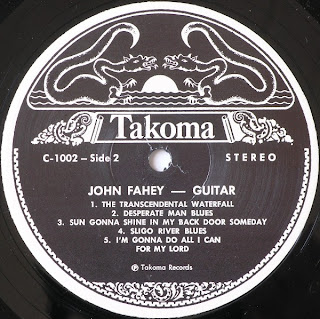
Circa 2005 reissue of 1959 release:


For the photos of the labels for the original 1959 release, my thanks to Glenn Jones. The recent reissue of that version appeared in two pressings, one a basic pressing and the other on audiophile 180gm vinyl. Both are pressed from the same master and I can discern no difference in the (very good) sound. They are a wonderful opportunity to listen to a record that has never been available before, other than that rare and now absurdly valuable original pressing.
Five of the tracks from the 1959 sessions did not make it onto the later releases, nor the CD, but you can find these here as downloads, plus the full St Louis Blues, which was shortened for the 1964 release:
West Coast Blues
St Louis Blues
In Christ There Is No East or West
The Transcendental Waterfall
On Doing an Evil Deed Blues
I have to put in something of a caveat on the final track; it is almost certain that 'Desperate Man Blues' was not re-recorded for the '64 release. The track that I recorded has a sound that is very lacking in top end, but the performance itself does appear the same. However, the muddy sound here (compared to the '64) does not replicate on 'St Louis Blues', despite both being presumably recorded from the same source. Fahey was certainly capable of delivering performances that border on the identical when he was of a mind to; nevertheless I definitely favour the notion that the track was not re-recorded. But it's here anyway, so you can judge for yourself.
Desperate Man Blues
I am grateful to Paul Bryant for pointing out that 'The Transcendental Waterfall' on the 1967 recording of this album is not, despite the information on the CD liner notes, an edited version of the 1964 recording, but an entirely fresh performance. Here is a link to download the 1967 stereo recording:
The Transcendental Waterfall


Circa 1965:


The 1968 release:


Circa 1970:


Circa 1972 (monaural):


Circa 1972 (stereo):


Circa 1977:


Circa 2005 reissue of 1959 release:


For the photos of the labels for the original 1959 release, my thanks to Glenn Jones. The recent reissue of that version appeared in two pressings, one a basic pressing and the other on audiophile 180gm vinyl. Both are pressed from the same master and I can discern no difference in the (very good) sound. They are a wonderful opportunity to listen to a record that has never been available before, other than that rare and now absurdly valuable original pressing.
Five of the tracks from the 1959 sessions did not make it onto the later releases, nor the CD, but you can find these here as downloads, plus the full St Louis Blues, which was shortened for the 1964 release:
West Coast Blues
St Louis Blues
In Christ There Is No East or West
The Transcendental Waterfall
On Doing an Evil Deed Blues
I have to put in something of a caveat on the final track; it is almost certain that 'Desperate Man Blues' was not re-recorded for the '64 release. The track that I recorded has a sound that is very lacking in top end, but the performance itself does appear the same. However, the muddy sound here (compared to the '64) does not replicate on 'St Louis Blues', despite both being presumably recorded from the same source. Fahey was certainly capable of delivering performances that border on the identical when he was of a mind to; nevertheless I definitely favour the notion that the track was not re-recorded. But it's here anyway, so you can judge for yourself.
Desperate Man Blues
I am grateful to Paul Bryant for pointing out that 'The Transcendental Waterfall' on the 1967 recording of this album is not, despite the information on the CD liner notes, an edited version of the 1964 recording, but an entirely fresh performance. Here is a link to download the 1967 stereo recording:
The Transcendental Waterfall
Death Chants, Breakdowns, and Military Waltzes
The original 1963 release:


Circa 1965:


The 1968 release:
Circa 1970:
Circa 1972:


Circa 1973:


The 1972 'dragon' label came initially and very briefly claiming to be 'Monaural'; it wasn't of course. This appears to be the only dragon label that uses that moniker, despite many mono records remaining in the catalogue.
With the 1967 sleeve, the track listings for the two sides are reversed on the back. I suspect Takoma got a bit confused, meaning to do it on 'Dance of Death' instead (see my notes with the entry for that album). The track 'Take a Look at That Baby' is not listed on the cover at all. These mistakes were repeated on the 1968 cover.


Circa 1965:


The 1968 release:


Circa 1970:


Circa 1972:


Circa 1973:


The 1972 'dragon' label came initially and very briefly claiming to be 'Monaural'; it wasn't of course. This appears to be the only dragon label that uses that moniker, despite many mono records remaining in the catalogue.
With the 1967 sleeve, the track listings for the two sides are reversed on the back. I suspect Takoma got a bit confused, meaning to do it on 'Dance of Death' instead (see my notes with the entry for that album). The track 'Take a Look at That Baby' is not listed on the cover at all. These mistakes were repeated on the 1968 cover.
Dance of Death & Other Plantation Favorites
The original 1965 release:


Circa 1965:


Circa 1970:


Circa 1972:


Later copies of this record are labelled as stereo but they aren't; regardless of labelling all pressings of this record were actually mono.
The original label design for this record is as far as I am aware unique, never used on any other Takoma release. The second design actually uses different typefaces on each side of the record (look at the centre of the 'O' in 'TAKOMA')! I have other copies that use one or the other, but never both together.
Matrices for this record are: 'SCORE: TAKOMA 4 FAHEY 3 - A' and 'SCORE: TAKOMA 4 FAHEY 3 - B'. And there's an interesting story here too; the gentleman who mastered the disc was so amused by his little joke in presenting the matrix numbers as a score that he put the 'A' and the 'B' on the wrong sides of the masters (or maybe he was told to?). This caused some chaos, with the labels being put on the wrong sides for some time. If you look at the labels above you will see that the Dragon label transfers the track listing between the sides and this puts the track listings on the label in line with what's on the vinyl (but now the opposite to what is printed on the sleeve!). The only copy I have seen that is correctly labelled and matches the sleeve listing is that very first pressing. It gets slightly more complicated in that there is a 'hidden' track at the end of 'Give Me Cornbread When I'm Hungry'. People tend to think that this bonus track is only to be found on rare early pressings, but it is actually on all US copies pressed between 1965 and 1979. But people who go looking for it, if the album is mislabelled, tend to play 'Worried Blues' believing it to be 'Cornbread', and then think that they don't have the bonus track. For confusion, it's not exactly in the 'Voice of the Turtle' class, but it can take some getting your head around. The tune that appears at the end of 'Cornbread' is called 'Country Blues'. I originally put up the beginning of 'Dance of Death' in error, and look rather foolish as a result, but here is the correct Country Blues as a download; it isn't on the CD. My thanks to Malcolm Kirton for being very patient in correcting me, and for elucidating the connection between 'Cornbread' and 'Country Blues', which is that Dock Boggs' original 'Country Blues' includes the lines:
Give me cornbread when I'm hungry, good people, corn whiskey when I'm dry
Pretty women a-standing around me
Sweet heaven when I die
The Adelphi sessions which produced this album turned up many outtakes, and here is the first: Television Song
In 1967, the first three albums were repackaged. Volumes 1 & 2 were new recordings, but this one wasn't. It was retitled 'Volume 3: The Dance of Death and Other Plantation Favorites'.


Circa 1965:


Circa 1970:


Circa 1972:


Later copies of this record are labelled as stereo but they aren't; regardless of labelling all pressings of this record were actually mono.
The original label design for this record is as far as I am aware unique, never used on any other Takoma release. The second design actually uses different typefaces on each side of the record (look at the centre of the 'O' in 'TAKOMA')! I have other copies that use one or the other, but never both together.
Matrices for this record are: 'SCORE: TAKOMA 4 FAHEY 3 - A' and 'SCORE: TAKOMA 4 FAHEY 3 - B'. And there's an interesting story here too; the gentleman who mastered the disc was so amused by his little joke in presenting the matrix numbers as a score that he put the 'A' and the 'B' on the wrong sides of the masters (or maybe he was told to?). This caused some chaos, with the labels being put on the wrong sides for some time. If you look at the labels above you will see that the Dragon label transfers the track listing between the sides and this puts the track listings on the label in line with what's on the vinyl (but now the opposite to what is printed on the sleeve!). The only copy I have seen that is correctly labelled and matches the sleeve listing is that very first pressing. It gets slightly more complicated in that there is a 'hidden' track at the end of 'Give Me Cornbread When I'm Hungry'. People tend to think that this bonus track is only to be found on rare early pressings, but it is actually on all US copies pressed between 1965 and 1979. But people who go looking for it, if the album is mislabelled, tend to play 'Worried Blues' believing it to be 'Cornbread', and then think that they don't have the bonus track. For confusion, it's not exactly in the 'Voice of the Turtle' class, but it can take some getting your head around. The tune that appears at the end of 'Cornbread' is called 'Country Blues'. I originally put up the beginning of 'Dance of Death' in error, and look rather foolish as a result, but here is the correct Country Blues as a download; it isn't on the CD. My thanks to Malcolm Kirton for being very patient in correcting me, and for elucidating the connection between 'Cornbread' and 'Country Blues', which is that Dock Boggs' original 'Country Blues' includes the lines:
Give me cornbread when I'm hungry, good people, corn whiskey when I'm dry
Pretty women a-standing around me
Sweet heaven when I die
The Adelphi sessions which produced this album turned up many outtakes, and here is the first: Television Song
In 1967, the first three albums were repackaged. Volumes 1 & 2 were new recordings, but this one wasn't. It was retitled 'Volume 3: The Dance of Death and Other Plantation Favorites'.
Subscribe to:
Posts (Atom)

